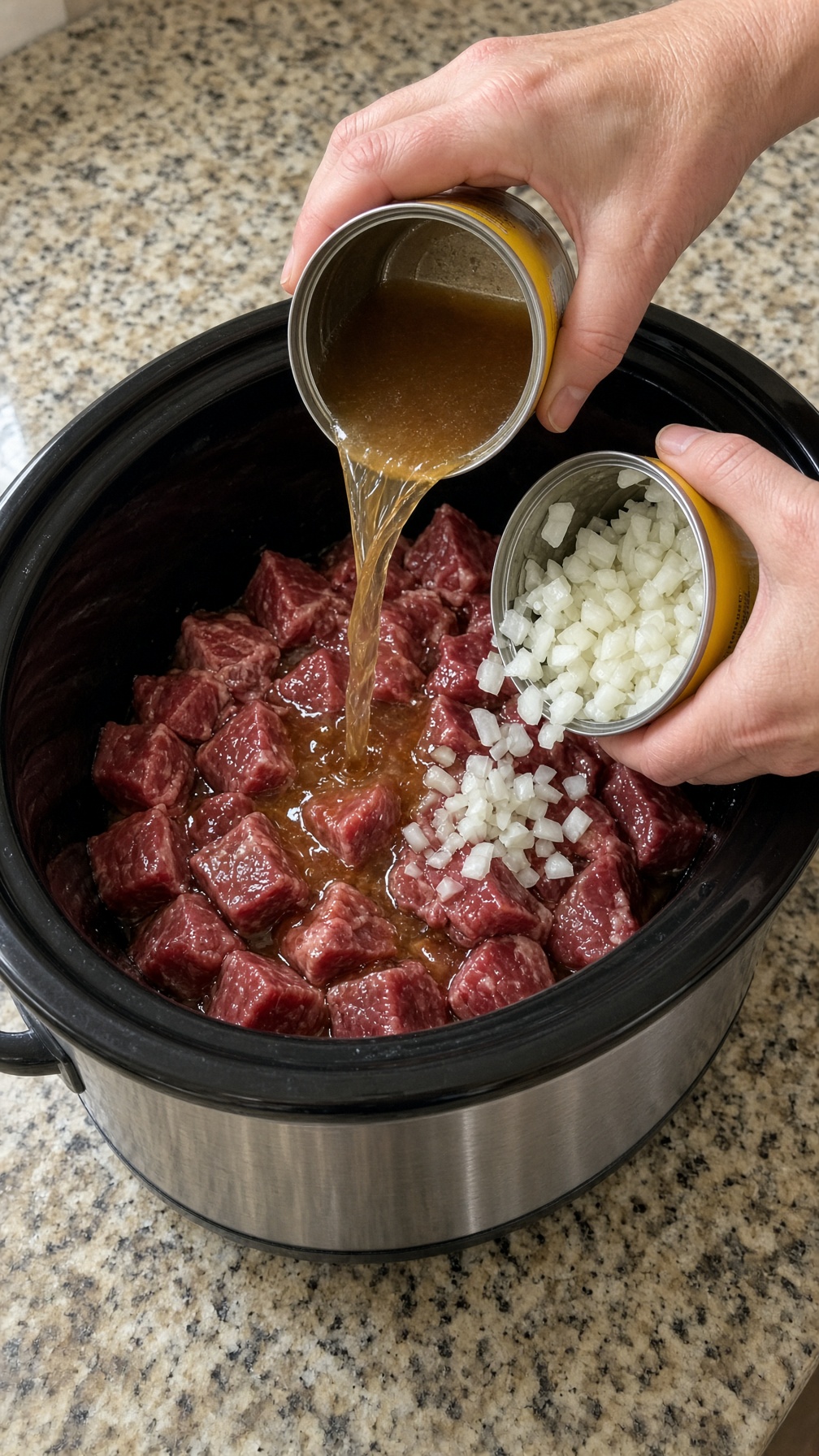
There’s something especially comforting about Slow Cooker Beef Tips with Onion Gravy. Tender chunks of beef slowly cook with sweet onions, garlic, beef broth, Worcestershire sauce, and herbs until the meat is fork-tender and surrounded by a thick, savory gravy.
Serve these beef tips over creamy mashed potatoes, buttery egg noodles, rice, or pasta for an easy family dinner that tastes like classic Sunday comfort food.
The recipe is also ideal for meal prep because the beef reheats beautifully when stored with plenty of gravy.
Why You’ll Love This Recipe
- Fork-tender slow-cooked beef
- Rich onion gravy made from the cooking juices
- Easy family dinner
- Excellent with mashed potatoes
- Budget-friendly chuck roast
- Minimal hands-on cooking
- Great for leftovers
- Freezer-friendly
- Easy mushroom or creamy variations
Ingredients
For the Beef Tips
- 2½ pounds beef chuck roast, cut into 1½-inch pieces
- 1½ tablespoons olive oil
- 1 teaspoon kosher salt
- ¾ teaspoon black pepper
- 1 teaspoon garlic powder
- 1 teaspoon onion powder
- ½ teaspoon smoked paprika
- 2 tablespoons all-purpose flour
For the Onion Gravy
- 2 large yellow onions, thinly sliced
- 3 garlic cloves, minced
- 2 tablespoons unsalted butter
- 2½ cups low-sodium beef broth
- 2 tablespoons Worcestershire sauce
- 1 tablespoon tomato paste
- 1 teaspoon dried thyme
- ½ teaspoon dried rosemary
- ½ teaspoon black pepper
- 1 teaspoon soy sauce, optional
For Thickening
- 3 tablespoons cornstarch
- 3 tablespoons cold water
For Finishing
- 1 tablespoon butter, optional
- Fresh parsley
- Cracked black pepper
Best Beef for Slow Cooker Beef Tips
For a long slow-cooker recipe, chuck roast is one of the best choices.
Chuck contains connective tissue and marbling that benefit from several hours of gentle cooking. As it cooks, the connective tissue softens and the beef develops the tender texture you want in this recipe.
Pre-cut stew meat can also work, although packages can contain pieces from different cuts, so tenderness may be less consistent.
Sirloin is another possibility, but because it is leaner and naturally more tender, it doesn’t benefit from an all-day cook in quite the same way.
How to Make Slow Cooker Beef Tips with Onion Gravy
Step 1: Prepare the Beef
Cut the chuck roast into approximately 1½-inch pieces.
Trim large pieces of hard exterior fat while leaving some marbling.
Pat the beef thoroughly dry with paper towels.
Dry beef browns much more effectively.
Step 2: Season
Combine the beef with:
- Salt
- Black pepper
- Garlic powder
- Onion powder
- Smoked paprika
Sprinkle the flour over the beef and toss lightly.
The thin flour coating helps with browning and eventually contributes a little body to the gravy.
Step 3: Heat Your Skillet
Place a large cast-iron or stainless-steel skillet over medium-high heat.
Add the olive oil.
Wait until the skillet is properly hot.
Step 4: Sear the Beef
Add the beef in a single layer.
Don’t crowd the skillet.
Brown the pieces on several sides, then transfer them to the slow cooker.
Work in batches when necessary.
You’re not trying to completely cook the beef at this stage—the goal is to develop a flavorful browned exterior.
Why Searing Is Worth the Extra Step
You can technically make slow-cooker beef without browning it first.
However, searing produces deeper roasted flavors that are difficult to develop inside the moist environment of a slow cooker.
It also leaves flavorful browned bits in the skillet.
Don’t throw those away.
We’re going to use them in the gravy.
Step 5: Sauté the Onions
Reduce the skillet to medium heat.
Add the butter and sliced onions.
Cook for approximately 5–7 minutes, stirring occasionally.
The onions should soften and begin developing golden edges.
Step 6: Add Garlic
Add the minced garlic.
Cook for about 30 seconds, just until fragrant.
Step 7: Cook the Tomato Paste
Add the tomato paste.
Stir it into the onions and cook for approximately one minute.
This helps remove some of the raw tomato flavor and adds savory depth.
Step 8: Deglaze the Pan
Pour approximately ½ cup of beef broth into the skillet.
Use a wooden spoon to scrape up the browned bits stuck to the bottom.
Those browned bits become part of your gravy.
Step 9: Transfer to the Slow Cooker
Pour the onion mixture over the beef.
Add the remaining beef broth.
Stir in:
- Worcestershire sauce
- Thyme
- Rosemary
- Black pepper
- Optional soy sauce
Mix gently.
Step 10: Slow Cook
Cover and cook approximately:
LOW: 6–8 hours
or
HIGH: 3–4 hours
Slow-cooker temperatures and beef cuts vary, so treat these as ranges rather than exact guarantees.
For chuck roast, LOW is generally the more forgiving option.
How Do You Know When Beef Tips Are Tender?
Don’t rely entirely on the clock.
Use a fork.
The beef should be very easy to cut or pull apart.
Chuck roast often becomes especially tender around 195–205°F (90–96°C) as connective tissue breaks down. This is a tenderness range rather than the minimum food-safety temperature.
If the beef still feels tough, it often needs additional cooking.
Step 11: Make the Cornstarch Slurry
Once the beef is tender, combine:
- 3 tablespoons cornstarch
- 3 tablespoons cold water
Whisk until completely smooth.
Step 12: Thicken the Gravy
Stir the slurry into the slow cooker.
Cover and cook on HIGH for approximately 10–20 minutes, or until the gravy thickens.
If your gravy reaches the consistency you like sooner, there’s no need to continue thickening it.
Step 13: Finish
Taste the gravy.
Adjust salt and pepper.
For a richer finish, stir in 1 tablespoon butter.
Step 14: Serve
Spoon the beef tips and onion gravy over creamy mashed potatoes or egg noodles.
Finish with parsley and freshly cracked black pepper.
How to Get Exceptionally Tender Beef Tips
The biggest mistake with this dish is treating chuck roast like steak.
Chuck needs time.
At an intermediate stage of cooking, the beef can actually seem tough even though it has been cooking for hours.
That’s because the connective tissue hasn’t softened enough yet.
Continue cooking gently and test again later.
Once properly tenderized, the difference is dramatic.
Chuck Roast vs. Sirloin vs. Stew Meat
| Cut | Flavor | Texture After Slow Cooking | Best Use |
| Chuck roast | Rich | Very tender | Best overall |
| Sirloin | Beefy, leaner | Firmer | Shorter cooking |
| Stew meat | Varies | Varies | Convenient |
| Round | Mild, lean | Can be firmer | Budget option |
For an all-day slow-cooker dinner, chuck roast is my preferred choice.
Don’t Cut the Beef Too Small
Tiny pieces cook faster and can eventually become dry.
Chunks approximately 1½ inches across give you a better balance between:
- Browning
- Tenderness
- Moisture
- Attractive presentation
Why You Should Brown in Batches
If you put all the beef into one skillet simultaneously, the pan temperature drops dramatically.
The meat releases water.
Instead of developing a dark crust, it begins steaming.
If necessary, use three batches.
The extra few minutes are worthwhile.
Building Better Onion Gravy
The gravy isn’t simply beef broth thickened with cornstarch.
Its flavor comes from several layers:
browned beef + onions + garlic + tomato paste + beef broth + Worcestershire + herbs + cooking juices.
That’s why the skillet preparation matters.
Onions Are a Major Ingredient
Two large onions may initially look like a lot.
They aren’t.
Over several hours they soften considerably and become integrated into the gravy.
For an even stronger onion flavor, use three onions.
Caramelized Onion Variation
If you have extra time, cook the onions longer before adding them to the slow cooker.
Allow them to become deeply golden.
This gives the gravy a sweeter, richer onion flavor.
French Onion-Inspired Beef Tips
Increase the onions and cook them until deeply golden.
Once the beef is finished, add a small amount of:
- Gruyère
- Swiss
- Provolone
Serve over mashed potatoes or toasted bread.
This creates a French onion-inspired variation rather than a traditional French onion dish.
Mushroom Beef Tips and Gravy
Mushrooms pair naturally with beef and onion gravy.
Use approximately:
8–12 ounces sliced cremini or baby bella mushrooms.
For the best flavor, brown the mushrooms in the skillet before transferring them to the slow cooker.
Why You Should Brown Mushrooms
Mushrooms contain a lot of water.
Adding them raw can introduce additional liquid into the slow cooker.
Browning concentrates their flavor and removes some moisture.
Creamy Mushroom Beef Tips
Prepare the mushroom variation.
Once the beef is completely tender, finish the gravy with approximately:
½ cup heavy cream
or
½ cup sour cream.
If using sour cream, stir it in gently near the end rather than aggressively boiling it.
Beef Stroganoff-Inspired Variation
Add mushrooms and finish with sour cream.
Serve the beef over wide egg noodles.
You’ll have a dish with flavors reminiscent of beef stroganoff while retaining the slow-cooked beef-tip preparation.
Garlic Butter Beef Tips
For more garlic flavor, increase the garlic slightly.
Once cooking is finished, stir in:
- Butter
- Fresh parsley
- Small amount of roasted garlic
This creates a richer steakhouse-inspired finish.
Peppercorn Beef Tips
Increase freshly cracked black pepper.
Finish with a little heavy cream.
The creamy pepper sauce pairs particularly well with mashed potatoes.
Can I Add Onion Soup Mix?
Yes.
It’s an easy shortcut.
However, onion soup mix can contain substantial sodium.
If using it:
- Choose low-sodium beef broth.
- Reduce added salt.
- Taste before seasoning at the end.
Can I Use a Gravy Packet?
You can, although you don’t need one.
The natural cooking liquid can be turned into an excellent gravy with a simple cornstarch slurry.
Making it this way also gives you more control over seasoning and thickness.
Worcestershire Sauce
Worcestershire adds savory depth and acidity.
A couple of tablespoons is enough to enhance the beef without making the sauce taste strongly of Worcestershire.
Optional Soy Sauce
Soy sauce contributes additional umami.
Use only a small amount.
Because it contains sodium, don’t automatically add additional salt afterward.
Taste first.
Why Use Low-Sodium Beef Broth?
The sauce cooks for hours.
As flavors concentrate, salt becomes more noticeable.
Starting with low-sodium broth gives you more control.
Cornstarch vs. Flour Gravy
Both methods work.
Cornstarch is particularly convenient at the end of slow cooking.
| Thickener | Texture | Method |
| Cornstarch | Glossy, smooth | Cold-water slurry |
| Flour | Traditional | Roux or flour slurry |
| Reduction | Concentrated | Simmer liquid separately |
How to Make a Cornstarch Slurry Correctly
Always mix cornstarch with cold liquid first.
A simple ratio is equal parts cornstarch and cold water.
Mix thoroughly.
Then stir into hot gravy.
Adding dry cornstarch directly to hot liquid can create unpleasant lumps.
What If the Gravy Is Too Thin?
Make an additional small slurry using:
- 1 tablespoon cornstarch
- 1 tablespoon cold water
Add gradually.
Give the gravy time to thicken before deciding whether you need more.
What If the Gravy Is Too Thick?
Add warm beef broth a few tablespoons at a time.
Stir gently until the desired consistency returns.
What If the Gravy Is Too Salty?
Prevention is easier than correction.
That’s why low-sodium broth is recommended.
If it does become overly salty, increasing the volume with unsalted broth can help dilute it.
Serving over unsalted or lightly seasoned potatoes can also balance the meal.
Why Is My Gravy Greasy?
Chuck contains natural fat.
Some is desirable.
Too much can make the sauce oily.
Before thickening, use a spoon to skim excess fat from the surface.
A gravy fat separator can also be helpful.
Mashed Potatoes: The Classic Pairing
Creamy mashed potatoes are arguably the best partner for beef tips.
They absorb the onion gravy beautifully.
Yukon Gold potatoes provide a naturally buttery texture.
For extra-creamy potatoes, add warm milk or cream and butter.
Beef Tips and Egg Noodles
Wide egg noodles are another excellent choice.
Cook them separately.
Toss with a little butter and parsley.
Spoon the beef and gravy over the noodles immediately before serving.
Don’t Slow Cook the Noodles All Day
Pasta doesn’t need the same cooking time as chuck roast.
Adding noodles at the beginning would leave them extremely soft.
Cook them separately for better texture.
Beef Tips with Rice
White rice is inexpensive and excellent at absorbing gravy.
Brown rice also works.
Again, prepare it separately.
Beef Tips with Polenta
For something different, serve the beef over creamy polenta.
The soft cornmeal base works exceptionally well with rich gravy.
Vegetable Side Dishes
Because the beef and gravy are rich, vegetables provide useful contrast.
Try:
- Green beans
- Roasted broccoli
- Asparagus
- Brussels sprouts
- Glazed carrots
- Garden salad
Add Carrots to the Slow Cooker
Large carrot pieces can cook directly with the beef.
They become tender and slightly sweet.
This moves the dish closer to a traditional pot-roast-style dinner.
Add Potatoes
Baby potatoes or chunks of Yukon Gold can also be added.
However, if you’re planning to serve the beef over mashed potatoes, adding potatoes to the slow cooker isn’t necessary.
Can I Add Peas?
Yes.
Add frozen peas near the end.
They only need enough time to heat through.
Adding them early can make them overly soft.
LOW vs. HIGH
For chuck roast, LOW generally gives you the widest margin for error.
| Setting | Typical Range | Best For |
| LOW | 6–8 hours | Maximum tenderness |
| HIGH | 3–4 hours | Faster dinner |
| WARM | After cooking | Short-term holding |
Actual cooking performance varies between appliances.
Why Is My Beef Tough After 6 Hours?
It may simply need longer.
This is especially common with large pieces of chuck.
Continue cooking and check periodically until a fork slides easily into the meat.
Why Did My Beef Dry Out?
Possible causes include:
- Very lean beef
- Pieces cut too small
- Excessively long cooking
- Insufficient cooking liquid
- Using a cut poorly suited to long cooking
Well-marbled chuck is more forgiving.
Can I Start with Frozen Beef?
For slow-cooker cooking, thaw the beef safely in the refrigerator first.
Starting with thawed beef provides more predictable cooking and safer temperature progression.
Can I Prepare This the Night Before?
You can prepare many components in advance.
Cut the beef.
Slice the onions.
Measure the seasonings.
Store everything covered in the refrigerator.
Then sear and assemble the slow cooker the following day.
Meal Prep
Beef tips are excellent for meal prep because gravy helps protect the meat during reheating.
Build containers with:
- Beef tips
- Onion gravy
- Mashed potatoes or rice
- Green vegetables
How to Store Leftovers
Cool and refrigerate leftovers promptly in airtight containers.
For best quality, use within approximately 3–4 days.
Keep plenty of gravy around the beef.
How to Reheat Beef Tips
Stovetop
Transfer beef and gravy to a saucepan.
Add a splash of beef broth if the gravy has become very thick.
Warm gently.
Microwave
Place an individual portion in a microwave-safe container.
Heat in short intervals, stirring between rounds.
Can You Freeze Beef Tips?
Yes.
This is an excellent freezer-friendly recipe.
Cool completely.
Transfer beef and gravy into freezer-safe containers.
Freeze individual portions when convenient.
Freezing with Gravy
Always include gravy with the beef.
The gravy helps protect the meat from drying during reheating.
For best texture, prepare fresh egg noodles after thawing rather than freezing them with the beef.
Best Slow Cooker Size
A 6-quart slow cooker works well for approximately 2½ pounds of beef.
Don’t overfill your appliance.
Follow its manufacturer’s recommended capacity and operating instructions.
Best Skillet for Browning
A heavy stainless-steel or cast-iron skillet is excellent.
These pans tolerate high heat and develop strong browning.
A 12-inch skillet gives the beef more surface area.
Useful Kitchen Equipment
This recipe benefits from:
- 6-quart slow cooker
- 12-inch skillet
- Sharp chef’s knife
- Large cutting board
- Kitchen tongs
- Wooden spoon
- Measuring cups
- Measuring spoons
- Instant-read thermometer
- Fat separator, optional
- Airtight meal-prep containers
Budget-Friendly Tips
Chuck roast is often more economical than premium steak and is actually better suited to this long cooking method.
Stretch the meal further with:
- Extra onions
- Mushrooms
- Carrots
- Mashed potatoes
- Egg noodles
- Rice
A generous serving of gravy makes inexpensive sides feel much more substantial.
Serving for a Crowd
For a family gathering, make the beef in advance.
Keep the beef with its gravy and reheat gently.
Prepare a large batch of mashed potatoes shortly before serving.
Set out:
- Beef tips
- Mashed potatoes
- Onion gravy
- Green beans
- Dinner rolls
It’s a simple but satisfying comfort-food spread.
Restaurant-Style Presentation
Spoon mashed potatoes into a shallow bowl.
Create a small well.
Add several pieces of beef.
Spoon the glossy onion gravy over the beef and potatoes.
Finish with:
- Fresh parsley
- Cracked black pepper
Keep the edges of the plate clean for a polished presentation.
Common Mistakes to Avoid
Skipping the Browning
You’ll miss a major opportunity to build flavor.
Overcrowding the Skillet
Sear in batches.
Cutting the Beef Too Small
Larger pieces remain juicier.
Adding Excess Liquid
Slow cookers retain moisture.
Oversalting Early
Broth, Worcestershire, and soy sauce already contribute sodium.
Adding Dry Cornstarch to Hot Gravy
Always make a cold slurry.
Giving Up When Chuck Is Still Tough
It may simply need more cooking time.
Starting with Frozen Beef
Thaw safely in the refrigerator first.
Cooking Noodles All Day with the Beef
Prepare pasta separately.
Frequently Asked Questions
What is the best beef for slow cooker beef tips?
Chuck roast is one of the best choices because long, gentle cooking makes it tender and flavorful.
Should I sear beef tips first?
It’s optional but strongly recommended for deeper flavor.
Can I use stew meat?
Yes, although texture can vary depending on which cuts are included.
Can I add mushrooms?
Absolutely. Brown them first for better flavor and less excess moisture.
How do I thicken onion gravy?
Mix cornstarch with cold water, then stir the slurry into the hot cooking liquid.
Why is my beef still tough?
Chuck roast often needs additional cooking time for its connective tissue to soften.
Can I use cream of mushroom soup?
You can use it as a shortcut, but it will create a different, creamier gravy and can add considerable sodium.
Can I make this creamy?
Yes. Stir heavy cream or sour cream into the finished gravy.
What should I serve with beef tips?
Mashed potatoes, egg noodles, rice, or creamy polenta are excellent choices.
Can I make it ahead?
Yes. Beef tips and gravy reheat very well.
Can I freeze leftovers?
Yes. Freeze the beef together with plenty of gravy.
Final Thoughts
Slow Cooker Beef Tips with Onion Gravy is exactly the kind of recipe that makes a slow cooker worthwhile: an affordable cut of beef transforms into a tender, deeply savory dinner while the onions and cooking juices become a rich homemade gravy.
The key techniques are simple: use chuck roast, pat the beef dry, sear it in batches, deglaze the skillet, don’t add excessive liquid, and give the beef enough time to become genuinely fork-tender.
Finish the gravy with a cornstarch slurry, spoon everything generously over creamy mashed potatoes or buttery egg noodles, and you’ve got a hearty family dinner that’s just as good reheated the next day.