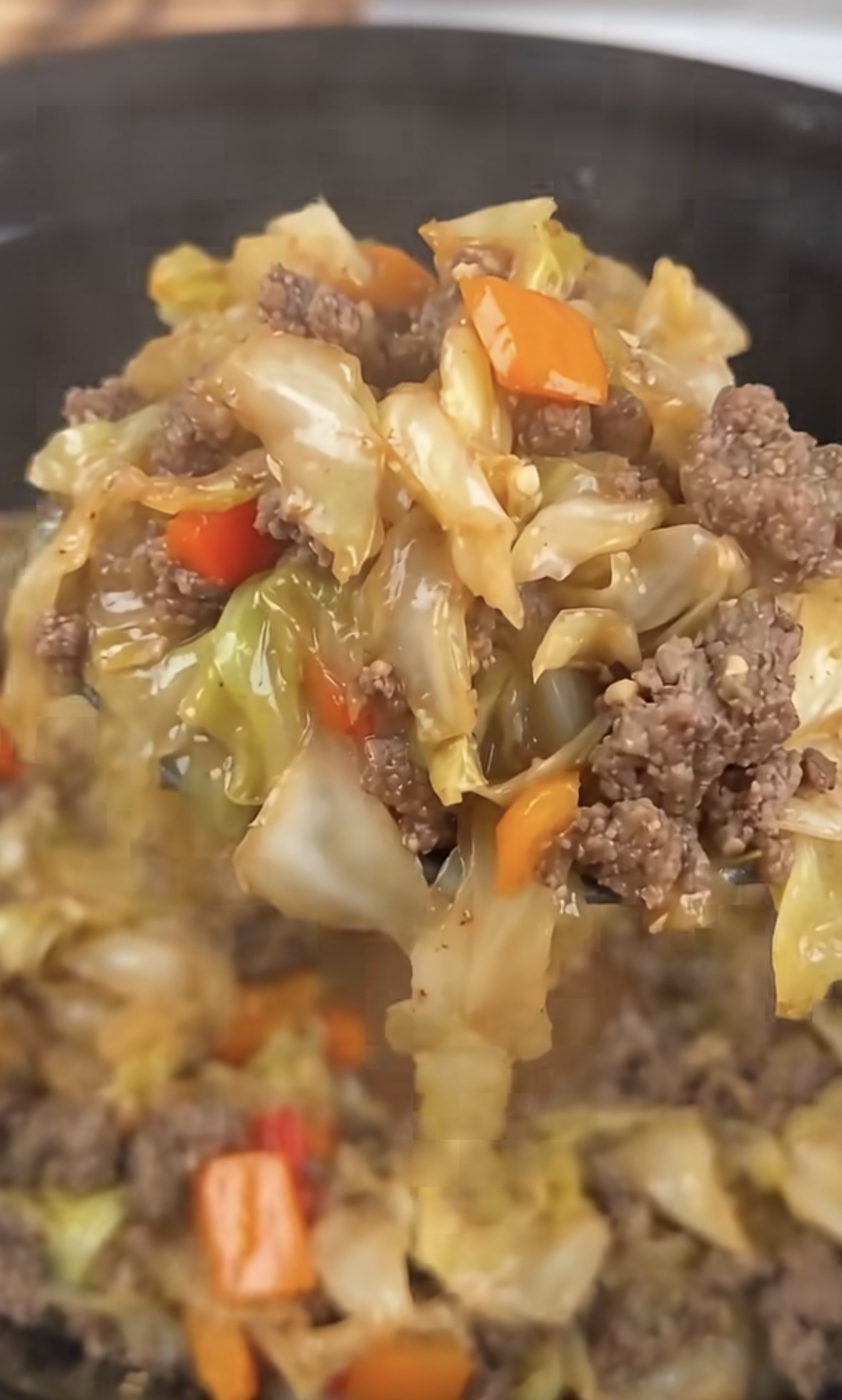
The Secret to Better Ground Beef Stir-Fry
One of the biggest upgrades is letting the beef brown properly.
Don’t stir constantly from the second it hits the skillet.
Let some of the meat make direct contact with the hot pan.
That creates deeper flavor.
Don’t Overcrowd the Pan
A large skillet works better than a small one.
When too much food is packed into a small pan, the ingredients steam.
For stir-fry, you want:
High heat + room to move + quick cooking
A 12-inch skillet is a good choice for this recipe.
Why Cabbage Works So Well with Ground Beef
Cabbage is inexpensive and mild, but it absorbs sauce extremely well.
It also adds:
- Volume
- Texture
- Natural sweetness
That makes it a great way to stretch one pound of beef into several servings.
How to Keep Cabbage from Becoming Mushy
Avoid overcooking.
Add cabbage after the beef and aromatics.
Cook just until:
- Slightly tender
- Still a little crisp
Remember that it will continue softening for a short time after leaving the heat.
How to Make the Cabbage Softer
If you prefer very tender cabbage, add a splash of water.
Cover the skillet for 2–3 minutes.
The steam will soften it quickly.
Then uncover and finish with the sauce.
Why Add Rice Vinegar?
Rice vinegar adds acidity.
This balances:
- Beef richness
- Sweetness
- Soy sauce
- Sesame oil
Without acidity, stir-fry sauces can taste heavy.
Soy Sauce vs. Low-Sodium Soy Sauce
Low-sodium soy sauce gives you more control.
Oyster sauce is already salty, so using reduced-sodium soy sauce helps keep the finished dish balanced.
What Does Oyster Sauce Add?
Oyster sauce contributes:
- Umami
- Slight sweetness
- Richness
- Glossy texture
A small amount makes the sauce taste more rounded.
Can You Make It Without Oyster Sauce?
Yes.
Replace it with:
- Extra soy sauce
- Hoisin sauce
- Teriyaki sauce
Each option changes the flavor slightly.
For a simple replacement, use soy sauce plus a tiny bit more sugar.
Spicy Ground Beef & Cabbage
Add:
- Crushed red pepper
- Sriracha
- Chili garlic sauce
- Chili crisp
For the best control, serve chili crisp at the table.
Garlic Lover’s Version
Increase the garlic to 5 or 6 cloves.
Add the garlic late enough that it doesn’t burn.
Garlic becomes bitter when cooked too aggressively.
Ginger Beef & Cabbage
Double the fresh ginger.
This gives the dish a brighter, more aromatic flavor.
Fresh ginger works better here than dried ginger.
Teriyaki Ground Beef & Cabbage
Replace the sauce with teriyaki sauce.
Add a little water if the sauce is very thick.
Finish with sesame seeds and green onions.
This creates a sweeter, family-friendly version.
Korean-Inspired Ground Beef & Cabbage
Use:
- Soy sauce
- Brown sugar
- Sesame oil
- Garlic
- Ginger
- Gochujang
Finish with sesame seeds and green onions.
Serve over rice.
Egg Roll in a Bowl Variation
This recipe is very close to an “egg roll in a bowl.”
Add:
- Shredded carrots
- Extra ginger
- Green onions
- Sesame oil
Skip the rice if you want a lighter bowl.
Ground Beef & Cabbage with Carrots
Add 1 cup shredded or julienned carrots.
Add them just before the cabbage.
They bring sweetness and color.
Ground Beef & Cabbage with Bell Peppers
Add sliced:
- Red bell pepper
- Yellow bell pepper
- Green bell pepper
Cook them with the onion.
This gives the stir-fry more crunch.
Mushroom Beef & Cabbage
Add sliced mushrooms.
Cook them before the cabbage so they have time to brown.
Good choices include:
- Cremini
- Button mushrooms
- Shiitake
Broccoli Beef & Cabbage
Add small broccoli florets.
Because broccoli takes longer than cabbage, add it first with a small splash of water.
Cover briefly to steam.
Then add cabbage.
Zucchini Variation
Add zucchini toward the end.
Zucchini releases water quickly, so don’t overcook it.
Can You Use Ground Turkey?
Yes.
Ground turkey works well.
Because it’s leaner, add a little oil if needed.
Cook to 165°F (74°C).
Can You Use Ground Chicken?
Yes.
Ground chicken is another lighter option.
Cook thoroughly to 165°F (74°C).
Add slightly more sesame oil or sauce if needed for richness.
Can You Use Ground Pork?
Absolutely.
Ground pork pairs beautifully with cabbage.
Cook it to 160°F (71°C).
Pork works particularly well in the egg-roll-inspired version.
Ground Beef vs. Ground Turkey
| Protein | Flavor | Fat | Best For |
| Ground beef | Rich | Moderate | Classic version |
| Ground turkey | Mild | Lower | Lighter meal |
| Ground chicken | Mild | Lower | Light stir-fry |
| Ground pork | Rich | Moderate | Egg-roll style |
Can You Use Steak Instead?
Yes.
Thinly sliced sirloin or flank steak works.
Cook the beef quickly over high heat.
Remove it from the skillet.
Cook the vegetables.
Return the steak at the end.
This prevents overcooking.
What to Serve with Ground Beef & Cabbage Stir-Fry
Serve it with:
- White rice
- Brown rice
- Jasmine rice
- Fried rice
- Noodles
- Cauliflower rice
It can also be eaten on its own.
Best Rice Pairing
Jasmine rice is especially good because its aroma pairs nicely with garlic, ginger, and sesame.
For meal prep, plain white rice is simple and reliable.
Ground Beef & Cabbage Noodles
Cook noodles separately.
Good choices include:
- Ramen
- Lo mein noodles
- Udon
- Rice noodles
Add cooked noodles to the skillet and toss with the sauce.
You may need to increase the sauce slightly.
Ramen Variation
Use two packages of plain ramen noodles.
Discard or save the seasoning packets.
Cook the noodles separately.
Toss with the beef and cabbage.
This creates a very affordable family dinner.
Low-Carb-Style Version
Serve the stir-fry without rice.
Or pair it with:
- Cauliflower rice
- Zucchini noodles
Cabbage already provides plenty of volume.
How to Make It More Filling
Add:
- Rice
- Noodles
- Extra beef
- Fried egg
A fried egg on top is especially good with the spicy version.
Add an Egg
Once the stir-fry is finished, cook fried or soft-boiled eggs separately.
Place one over each bowl.
The yolk adds richness to the sauce.
How to Make a Larger Batch
Double the ingredients, but consider cooking in two batches.
Trying to stir-fry a huge amount of cabbage in one skillet can create too much steam.
If using a large wok, you may have enough space for the full batch.
Best Skillet for Stir-Fry
A large skillet or wok is ideal.
Cast Iron
Excellent heat retention.
Stainless Steel
Excellent browning.
Nonstick
Easy cleanup.
Wok
Best for tossing larger amounts of vegetables.
Wok vs. Skillet
| Pan | Advantage | Best For |
| Wok | Lots of room | High-heat stir-fry |
| Stainless skillet | Great browning | Beef |
| Cast iron | Holds heat well | Deep searing |
| Nonstick | Easy cleanup | Beginner-friendly |
A large stainless-steel skillet is a great all-purpose choice.
Why a Meat Chopper Helps
A meat chopper breaks ground beef into small, even crumbles.
This helps the beef distribute evenly through the cabbage.
A wooden spoon works perfectly well too.
Make-Ahead Preparation
You can prep several ingredients ahead.
Slice:
- Cabbage
- Onion
- Green onions
Mix the sauce.
Store everything separately in airtight containers.
Then dinner comes together very quickly.
Can You Cook It Ahead?
Yes.
This dish reheats well.
For the best texture, slightly undercook the cabbage if you know you’ll be reheating it later.
Meal Prep Instructions
Divide into containers with:
- Beef and cabbage
- Rice
Store toppings separately.
Green onions and sesame seeds are best added after reheating.
How to Store Leftovers
Allow leftovers to cool appropriately.
Transfer to airtight containers.
Refrigerate promptly.
Enjoy within several days for the best quality.
How to Reheat
Skillet
Reheat over medium heat.
Add a small splash of water if needed.
Microwave
Heat individual portions in intervals.
Stir between intervals.
Avoid excessively reheating the cabbage or it can become very soft.
Can You Freeze Ground Beef & Cabbage Stir-Fry?
Yes, although cabbage becomes softer after freezing.
Cool completely.
Store in freezer-safe containers.
For the best texture, freeze without rice and prepare fresh rice when serving.
How to Prevent Watery Stir-Fry
Cabbage contains a lot of water.
To prevent excess liquid:
- Use high enough heat
- Don’t overcrowd the skillet
- Don’t cover unless intentionally steaming
- Cook sauce only briefly
If the skillet becomes watery, increase heat and let some liquid evaporate.
Why Is My Cabbage Watery?
Possible causes:
- Too much cabbage in a small skillet
- Heat was too low
- Cabbage was washed and not dried
- Too much added water
Cook uncovered until excess moisture evaporates.
Why Is My Beef Gray Instead of Brown?
The skillet may not have been hot enough.
Other causes include:
- Overcrowding
- Stirring constantly
- Excess moisture
Let the beef sit for short periods so it can brown.
Why Does My Stir-Fry Taste Bland?
Try adjusting:
- Soy sauce
- Ginger
- Garlic
- Rice vinegar
- Black pepper
- Chili sauce
Often the solution is a little more acidity or soy sauce.
Taste before adjusting.
Why Is My Stir-Fry Too Salty?
Dilute it with:
- More cabbage
- Cooked rice
- A small splash of water
Next time, use low-sodium soy sauce.
Why Is My Stir-Fry Too Sweet?
Add:
- Rice vinegar
- Soy sauce
- Chili
Acidity and salt help balance sweetness.
How to Make the Sauce Thicker
For a slightly thicker sauce, mix:
- 1 teaspoon cornstarch
- 1 tablespoon cold water
Add near the end.
Cook for about a minute until glossy.
Don’t add dry cornstarch directly.
How to Make It Saucy
Double the sauce ingredients.
This works especially well if serving the stir-fry over noodles.
Remember that additional sauce also adds more sodium.
Kid-Friendly Version
Skip:
- Red pepper flakes
- Chili crisp
Use a little extra honey.
Serve with rice.
This creates a mild sweet-savory flavor.
Budget-Friendly Tips
Ground beef and cabbage are great ingredients for feeding several people economically.
Save money by:
- Buying cabbage whole instead of pre-shredded
- Buying ground beef in larger packages
- Using store-brand soy sauce
- Serving with rice
- Adding carrots to stretch the dish
One pound of beef can make several generous servings when combined with cabbage.
Useful Kitchen Tools
Helpful equipment includes:
- Large skillet or wok
- Chef’s knife
- Cutting board
- Meat chopper
- Wooden spoon
- Kitchen tongs
- Measuring spoons
- Small mixing bowl
- Rice cooker
- Airtight meal-prep containers
A large skillet or wok is especially useful because giving cabbage enough space helps it stir-fry instead of steam.
Common Mistakes
Overcrowding the Pan
The ingredients steam.
Cooking Cabbage Too Long
It becomes mushy.
Burning Garlic
Add it after the onion.
Adding Too Much Sauce
The dish can become watery.
Using High-Sodium Ingredients Everywhere
Choose low-sodium soy sauce.
Forgetting Acidity
Rice vinegar balances the sauce.
Overcooking Lean Ground Meat
Stop once it’s safely cooked and browned.
Frequently Asked Questions
What type of cabbage is best?
Green cabbage is affordable, sturdy, and works very well.
Can I use a bag of coleslaw mix?
Yes. It’s an excellent shortcut.
Can I make this with ground turkey?
Yes. Cook ground turkey to 165°F (74°C).
Can I make it spicy?
Absolutely. Add chili crisp, sriracha, or red pepper flakes.
Can I make it without oyster sauce?
Yes. Use extra soy sauce or a little hoisin sauce.
Can I add noodles?
Yes. Ramen, udon, rice noodles, and lo mein noodles all work.
Can I meal prep it?
Yes. It reheats well.
Can I freeze it?
Yes, though the cabbage will be softer after thawing.
How do I stop the cabbage from becoming watery?
Use a large hot skillet and avoid overcrowding.
What should I serve with it?
Rice, noodles, or cauliflower rice are all excellent choices.
Final Thoughts
This Ground Beef & Cabbage Stir-Fry proves that simple ingredients can make a seriously satisfying dinner.
The key is to brown the ground beef well, keep the skillet hot, avoid overcooking the cabbage, and finish everything with a balanced savory sauce of soy, garlic, ginger, sesame, and rice vinegar.
Serve it over rice for an easy family dinner, toss it with noodles for a heartier meal, or enjoy it on its own for a lighter one-pan option.
It’s inexpensive, flexible, quick to prepare, and especially useful for those nights when you want dinner on the table without a complicated ingredient list.