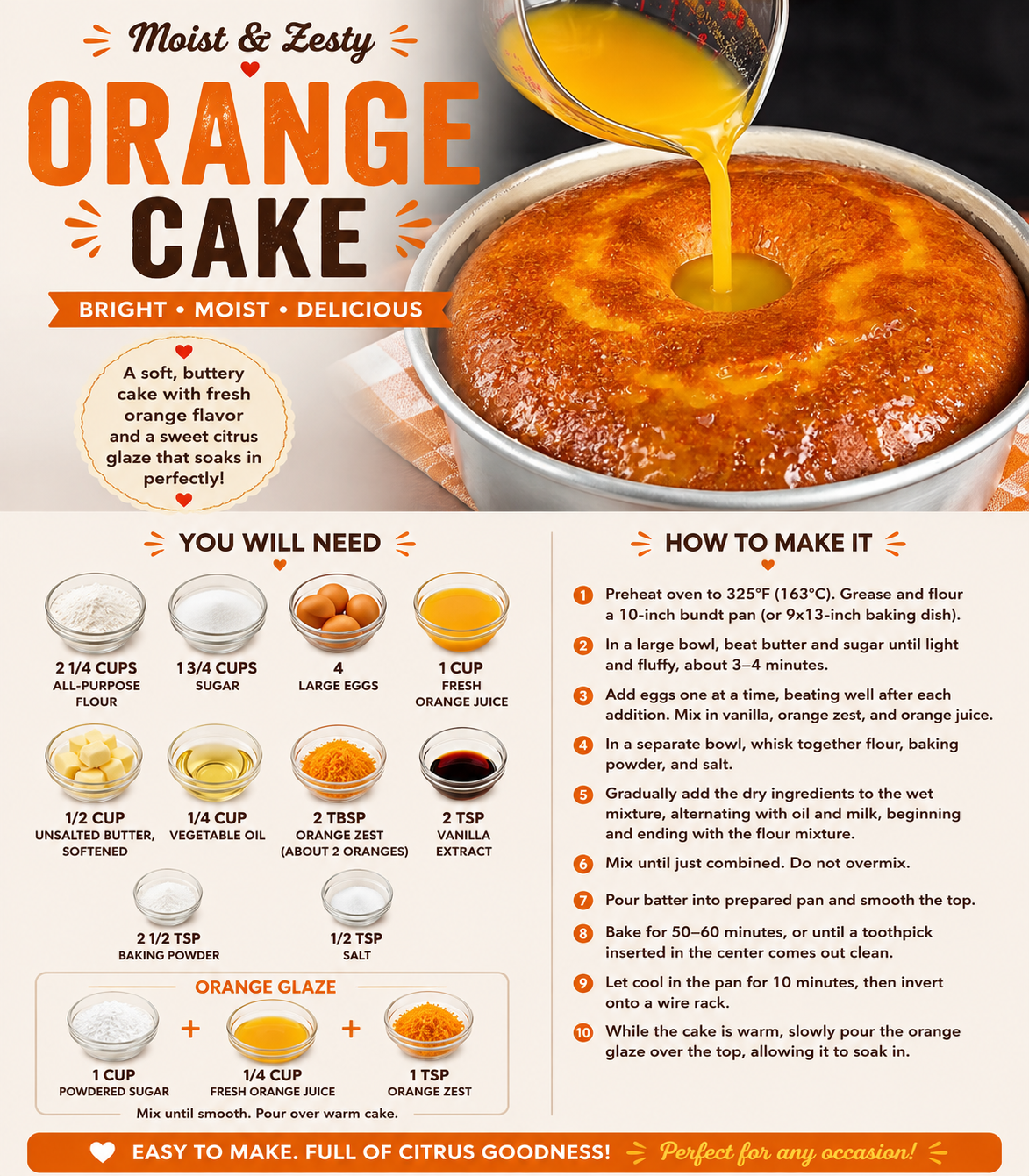
How to Make a Fresh Orange Glaze
An orange glaze is one of the easiest ways to intensify the citrus flavor.
Place powdered sugar in a bowl.
Gradually whisk in fresh orange juice.
Start with about 2 tablespoons.
Add more juice only if needed.
The glaze should be thick enough to coat the cake but fluid enough to drizzle.
Mix in a small amount of orange zest for extra flavor.
Pour the glaze over the completely cooled cake.
How to Make Orange Cake Extra Moist
Several small techniques can make a noticeable difference.
Use Oil
Oil helps the cake stay soft longer than butter alone.
Measure Flour Correctly
Too much flour is one of the most common causes of dry cake.
Do Not Overbake
Check the cake before the maximum suggested baking time.
Use Fresh Juice
Orange juice adds both flavor and moisture.
Store It Properly
Once completely cooled, keep the cake covered.
Exposure to air gradually dries baked goods.
Why Orange Zest Is So Important
Orange juice provides citrus flavor, but zest provides much of the aroma.
The colorful outer peel contains natural essential oils.
When zest is mixed with sugar or cake batter, those oils are released.
That is what gives homemade orange cake its fresh fragrance.
For even more flavor, rub the orange zest into the granulated sugar with your fingertips before mixing.
The sugar will begin to smell strongly of orange.
Oil vs. Butter in Orange Cake
Both can be used, but they create different results.
Oil
Oil produces:
- Softer texture
- Longer-lasting moisture
- Light crumb
Butter
Butter provides:
- Richer dairy flavor
- Slightly firmer texture
For a cake described as super moist, neutral vegetable oil is an excellent choice.
You can also combine oil and melted butter if you want both moisture and buttery flavor.
Can You Use Olive Oil?
Yes.
A mild olive oil can work beautifully with citrus.
However, strongly flavored extra-virgin olive oil will give the cake a more noticeable savory or fruity character.
If you want a classic sweet orange cake, use a neutral oil.
If you enjoy Mediterranean-style citrus cakes, olive oil can be a delicious variation.
Orange Yogurt Cake Variation
For an even softer texture, replace a small portion of the orange juice with plain Greek yogurt or sour cream.
These ingredients add:
- Moisture
- Richness
- Slight tanginess
A few spoonfuls are enough to noticeably change the crumb.
Orange Almond Cake Variation
Orange and almond flavors pair especially well.
Add ½ teaspoon almond extract to the batter.
You can also sprinkle sliced almonds over the glaze.
For a stronger almond flavor, replace a small portion of the flour with finely ground almond flour.
Because almond flour behaves differently from all-purpose flour, avoid replacing too much unless you are adjusting the overall recipe.
Orange Cranberry Cake
Orange and cranberry are a classic combination for fall and winter baking.
Fold dried cranberries into the batter.
Fresh cranberries can also work, although they add additional moisture and tartness.
This variation is especially good for Thanksgiving and Christmas brunch.
Chocolate Orange Cake
Chocolate and orange are another classic pairing.
You can add:
- Mini chocolate chips
- Dark chocolate chunks
- Chocolate glaze
Dark chocolate works particularly well because its slight bitterness balances the sweet citrus cake.
Orange Poppy Seed Cake
Add 1 to 2 tablespoons poppy seeds to the batter.
This creates a simple variation similar to traditional lemon-poppy seed cake.
Finish with orange glaze for extra citrus flavor.
Bundt Cake Variation
This batter can also be adapted to a Bundt-style presentation.
Use a properly greased Bundt pan and adjust baking time because the cake will be thicker.
A decorative Bundt cake finished with orange glaze makes a beautiful brunch or holiday dessert.
Always make sure the pan capacity is suitable for the amount of batter.
Loaf Cake Variation
For a café-style orange loaf, pour the batter into a prepared loaf pan.
Because the batter is deeper, baking time will generally be longer than for a round cake.
Check the center with a wooden skewer before removing it from the oven.
Finish with glaze for a bakery-style presentation.
Orange Cake for Brunch
This cake is especially good for brunch because it is sweet without being excessively rich.
Serve it alongside:
- Fresh fruit
- Coffee
- Tea
- Eggs
- Yogurt
- Breakfast casseroles
A light dusting of powdered sugar can be enough if you do not want a full dessert-style glaze.
Holiday Orange Cake
Fresh citrus is especially welcome during winter holiday baking.
For Christmas, garnish the cake with:
- Sugared cranberries
- Orange zest
- Fresh rosemary for decoration
- Powdered sugar
For Easter or spring gatherings, pair it with strawberries and whipped cream.
How to Measure Flour Correctly
If possible, use a digital kitchen scale.
One cup of all-purpose flour is generally around 120 to 125 grams depending on measuring method.
If using measuring cups:
- Fluff the flour.
- Spoon it into the cup.
- Level the top with a straight edge.
Do not press the flour down.
Too much flour can make even a well-designed cake recipe dry.
How to Prevent a Dense Cake
A dense orange cake can happen for several reasons.
Overmixing
Once flour is added, mix gently.
Old Baking Powder
Leavening loses effectiveness over time.
Incorrect Measurements
Too much flour or too little liquid can make batter heavy.
Low Oven Temperature
If the oven is not hot enough, the cake may rise poorly.
An inexpensive oven thermometer can help verify temperature accuracy.
Why Did My Cake Sink?
A cake may sink if:
- It was underbaked
- The oven door was opened too early
- Too much baking powder was used
- The batter was overmixed
- The cake experienced a sudden temperature change
Avoid opening the oven during the early baking stage.
Wait until the structure has had enough time to set.
How to Prevent Orange Cake From Sticking
Grease your baking pan thoroughly.
Line the bottom with parchment paper.
Let the cake cool briefly before removing it.
Trying to remove a very hot cake can cause it to break.
However, allowing some cakes to sit indefinitely in the pan can also encourage sticking.
About 10 to 15 minutes is usually a practical cooling period before transferring.
What to Serve With Orange Cake
Orange cake can be enjoyed plain or dressed up.
Try it with:
- Whipped cream
- Vanilla ice cream
- Fresh berries
- Greek yogurt
- Orange marmalade
- Lemon curd
- Chocolate sauce
- Fresh fruit salad
For afternoon coffee, a plain slice is often perfect.
For dessert, add whipped cream and berries.
Can You Make Orange Cake Ahead?
Yes.
Orange cake is a good make-ahead recipe because the oil helps it remain moist.
Bake it a day before serving.
Once completely cooled, wrap it tightly.
If using glaze, you can add it either the same day or shortly before serving.
How to Store Orange Cake
Store plain orange cake in an airtight cake container.
If your cake contains a dairy-based frosting or filling, refrigerate it.
For the best texture, allow refrigerated cake to sit briefly at room temperature before serving.
Always follow appropriate food-storage practices for perishable toppings.
Can You Freeze Orange Cake?
Yes.
Freeze it without glaze whenever possible.
Allow the cake to cool completely.
Wrap it tightly, then place it inside a freezer-safe container or bag.
Individual slices can also be frozen.
This is convenient if you want to enjoy one portion at a time.
Freezing Individual Slices
Cut the cooled cake into slices.
Wrap each slice separately.
Place the wrapped portions together in a freezer-safe food-storage bag.
Thaw at room temperature or in the refrigerator.
Add fresh glaze after thawing for the best appearance.
Useful Baking Tools
Helpful equipment for this recipe includes:
- 9-inch cake pan
- Mixing bowls
- Electric hand mixer
- Stand mixer
- Citrus juicer
- Microplane or fine grater
- Digital kitchen scale
- Measuring cups
- Silicone spatula
- Cooling rack
- Cake storage container
A citrus juicer and microplane are especially useful if you regularly make recipes with lemons, limes, or oranges.
Common Orange Cake Mistakes
Using Only Orange Juice
Do not skip the zest.
It provides much of the strongest orange flavor.
Overmixing the Batter
Mix only until the flour disappears.
Overbaking
Remove the cake as soon as it is properly baked.
Glazing While Hot
A hot cake will absorb or melt the glaze.
Cool it completely first.
Using Too Much Flour
Measure carefully.
Using Old Baking Powder
Check that your leavening is still active.
Frequently Asked Questions
Can I use bottled orange juice?
Yes, but fresh juice usually gives better flavor.
Which oranges are best?
Navel and Valencia oranges are excellent choices.
Can I use butter instead of oil?
Yes, although the finished cake may be slightly firmer.
Can I make this into cupcakes?
Yes.
Divide the batter into cupcake liners and reduce the baking time accordingly.
Can I add chocolate chips?
Absolutely.
Chocolate and orange pair very well.
Can I make it a day ahead?
Yes.
Orange cake stays moist when properly covered.
Why is my cake dry?
The most likely causes are too much flour or excessive baking time.
Do I need orange extract?
No.
Fresh zest and juice provide plenty of flavor, although a small amount of extract can be added if you want a stronger orange taste.
Can I make this cake without glaze?
Definitely.
Dust it lightly with powdered sugar instead.
How do I make the orange flavor stronger?
Use plenty of fresh zest and rub it into the sugar before preparing the batter.
Final Thoughts
Orange Cake (Super Moist and Fresh) is a simple homemade dessert with bright citrus flavor, a tender crumb, and enough moisture to stay delicious well after it comes out of the oven.
Fresh orange juice provides moisture while orange zest delivers the intense aroma that makes this cake stand out.
For the best results, measure the flour carefully, use fresh citrus, avoid overmixing, and check the cake before it has a chance to overbake.
Serve it plain with coffee, drizzle it with fresh orange glaze, or dress it up with whipped cream and berries for an easy dessert that works throughout the year.